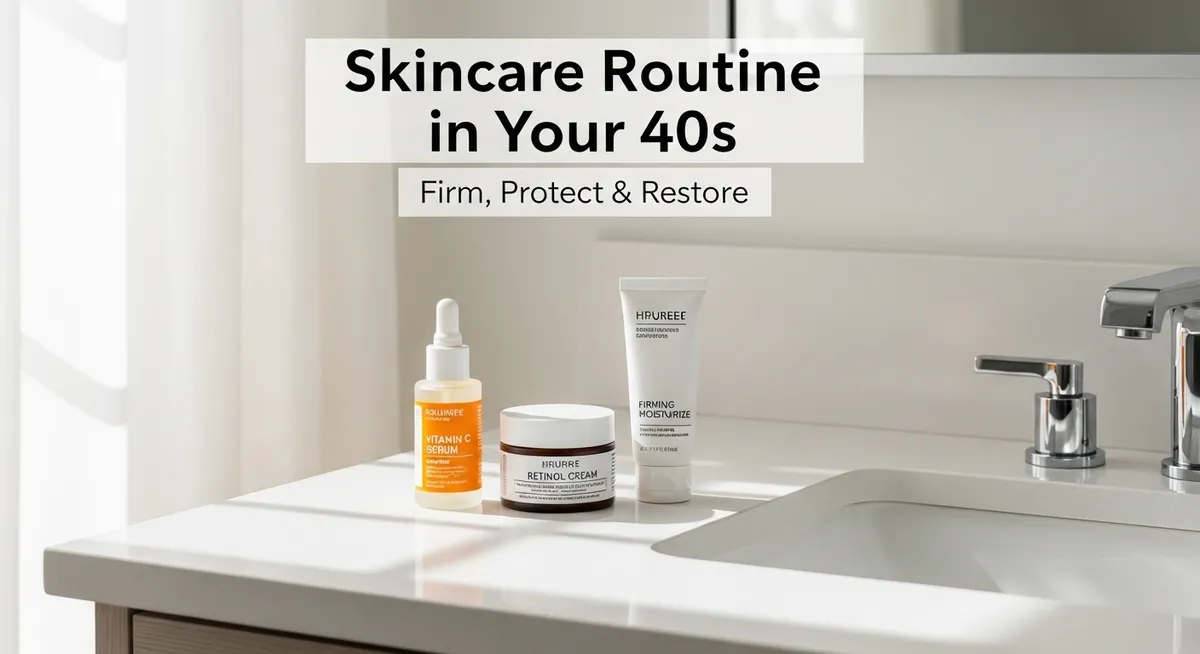
Intensive Repair: What Your Skin Needs Now
By age 40, your skin has lost roughly 20-30% of its peak collagen. The main concerns shift towards:
- Loss of Volume: Fat pads in the face begin to shift and descend, leading to hollowness or "sagging."
- Skin Thinning: The epidermis becomes thinner and more fragile, making the barrier easier to disrupt.
- Hyperpigmentation: "Age spots" or "sun spots" become more pronounced as melanocytes (pigment cells) become less regulated.
The Morning Routine: Structural Defense ☀️
Your morning in your 40s is about protecting your existing collagen and providing a visual "lift" through hydration.
Step 1: Non-Stripping Milk Cleanser
Avoid anything that makes your skin feel "tight." A milk or cream cleanser helps replenish essential oils while cleaning the skin.
Step 2: Vitamin C + Vitamin E
Use a stabilized 20% Vitamin C serum. This concentration is needed to effectively combat oxidative stress and brighten existing pigmentation.
Step 3: Growth Factors or Copper Peptides
Growth factors are proteins that help repair damaged tissues. Introducing them in the morning bolsters the skin's ability to withstand daily environmental damage.
Step 4: Rich Moisturizer with Ceramides
You likely need a thicker texture than you did in your 30s. Look for a cream that mimics the skin's natural moisture barrier.
Step 5: SPF 50+ (Broad Spectrum)
UV damage at 40 can exacerbate sagging. Ensure your SPF includes antioxidants and mineral blockers like Zinc Oxide for maximum protection.
The Night Routine: Deep Reconstruction 🌙
Nighttime is for the "heavy lifters." This is when you should use your highest-potency active ingredients.
Step 1: The Nourishing Double Cleanse
Start with a rich balm to ensure all environmental debris and sunscreen are removed without irritating thinning skin.
Step 2: Advanced Retinoid (Tretinoin or Retinal)
In your 40s, many dermatologists recommend moving from Retinol to Retinaldehyde (11x faster acting) or prescription Tretinoin to truly shift deep-set wrinkles and improve skin density.
Step 3: Multi-Molecular Hyaluronic Acid
Layer a serum with different weights of Hyaluronic Acid. The smaller molecules penetrate deep to plump the dermis, while larger ones sit on top to smooth the surface.
Step 4: The "Final Seal" Sleeping Mask
Finish with a rich, occlusive night cream to prevent Trans-Epidermal Water Loss (TEWL) while you sleep.
Don't Forget the Neck and Chest (Décolletage)
The skin on the neck has fewer oil glands and is often the first place to show "crepiness." In your 40s, treat your neck and chest as an extension of your face. Apply every serum and moisturizer from your chin down to your collarbone.
📊 Master Picks for Your 40s
| Concern | Intensive Product | Why it Wins |
|---|---|---|
| Deep Wrinkles | Medik8 Crystal Retinal 10 | Retinaldehyde tech; fast acting. |
| Skin Density | SkinMedica TNS Recovery Complex | Human growth factor technology. |
| Pigmentation | SkinCeuticals Discoloration Defense | Tranexamic + Kojic Acid. |
| Firming | Alastin Restorative Skin Complex | TriHex Technology for collagen. |
❓ Your 40s Skincare Questions Answered
Can skincare really fix sagging skin?
Skincare can improve skin firmness (tightness of the surface) and density (thickness of the dermis), which helps "lift" the look of skin. However, significant sagging caused by fat pad loss often requires professional treatments like fillers or Ultherapy.
Is it too late to start Retinol at 45?
Absolutely not! 45 is a fantastic time to start. Retinol studies show improvement in skin quality at any age. You just need to be more diligent with hydration and "sandwiching" your retinoid with moisturizer.
How often should I exfoliate in my 40s?
Less is more. Your skin's barrier is thinner now. Stick to twice a week with gentle PHA (Polyhydroxy Acids) or Lactic Acid, which hydrate while they exfoliate.

Ivana Dsouza
Beauty editor and skincare researcher at NxtLifestyle. Dedicated to finding scientifically-backed products that actually work.