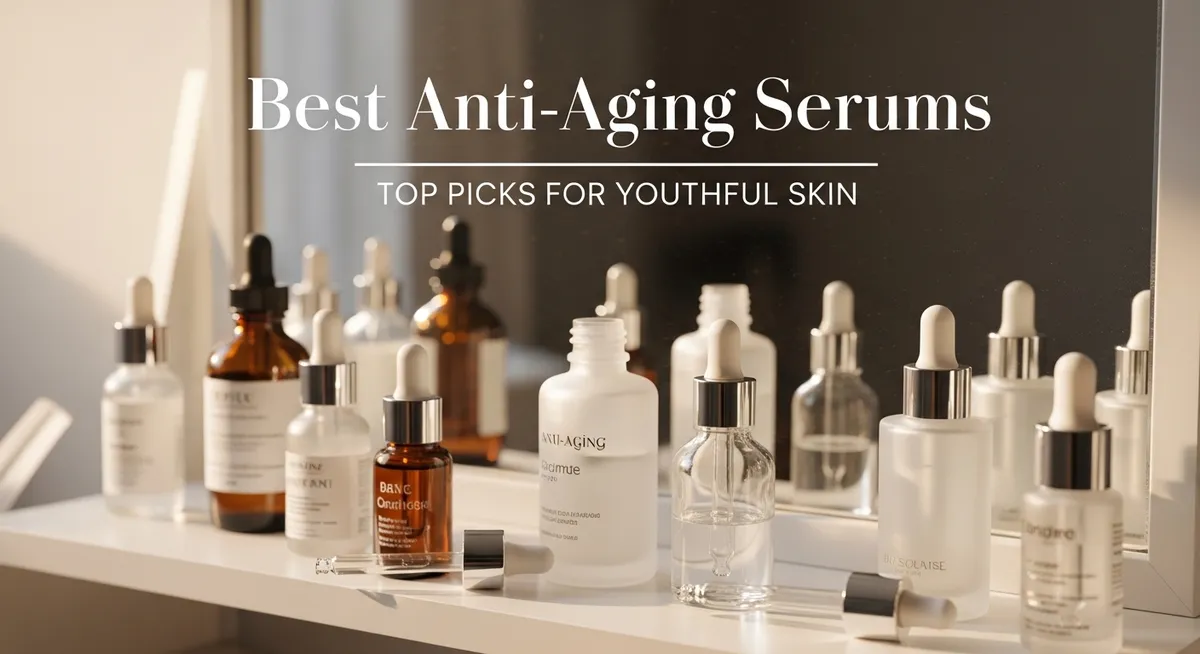
Our Top 3 Picks
🏆 Best Overall
Estée Lauder Advanced Night Repair
The iconic serum that hydrates and repairs.
Check Price🥈 Best Vitamin C
SkinCeuticals C E Ferulic
The dermatologist gold standard for brightness.
Check Price📊 Comparison Table: Best Anti-Aging Serums
| Product | Best For | Key Ingredient | Price |
|---|---|---|---|
| Estée Lauder ANR | Everything | Peptides + HA | $80 |
| SkinCeuticals CE | Dark Spots | 15% Vit C | $182 |
| Clarins Double Serum | Dry Skin | Turmeric | $90 |
| The Ordinary Buffet | Value | Copper Peptides | $18 |
| La Roche-Posay B5 | Plumping | Hyaluronic Acid | $39 |
| Kiehl's Dark Spot | Acne Scars | Vit C | $60 |
| Sunday Riley Good Genes | Texture | Lactic Acid | $85 |
| Cosrx Snail Mucin | Hydration | Snail Mucin | $25 |
| Murad Retinol | Wrinkles | Retinol | $92 |
| L'Oreal Revitalift | Budget HA | Hyaluronic | $20 |
Detailed Product Reviews
1. Estée Lauder Advanced Night Repair (ANR)
Best for: Everyone.
Why we love it: This little brown bottle is legendary. It uses patented technology to help skin repair itself from daily damage while you sleep. It's oil-free, sinks in instantly, and leaves skin looking well-rested, even if you aren't.
Pros:
- Deep hydration
- Strengthens skin barrier
- Works for all skin types
Cons: Expensive.
2. SkinCeuticals C E Ferulic
Best for: Brightening and protection.
Why we love it: It smells like hot dog water (seriously), but it works miracles. The combination of Vitamin C, E, and Ferulic Acid brightens sun spots and protects against pollution better than anything else on the market.
Pros:
- Clinical strength
- Prevents future damage
- Fades pigmentation
Cons: Very expensive and oxidizes quickly.
3. Clarins Double Serum
Best for: Anti-aging for dry skin.
Why we love it: It houses water-based and oil-based ingredients in separate chambers that mix when you pump. This mimics the skin's natural hydrolipidic film. Packed with 21 plant extracts like Tumeric, it makes skin radiate health.
Pros:
- Two-phase formula
- Instant glow
- Smells luxurious
Cons: Not for oily-skin" class="ingredient-link">oily skin.
4. The Ordinary "Buffet" (Multi-Peptide + HA)
Best for: Beginners on a budget.
Why we love it: It's like a protein shake for your face. This serum combines five different peptide technologies (including Matrixyl 3000 and Syn-Ake) to target multiple signs of aging at once. It's water-based, absorbs instantly, and costs less than a takeout lunch.
Pros:
- Incredible value
- Fragrance-free
- Plumps skin immediately
Cons: Can feel slightly tacky.
5. La Roche-Posay Hyalu B5 Serum
Best for: Dehydrated or sensitive skin.
Why we love it: If your skin feels tight or looks crepey, this is your drink of water. It uses two types of pure Hyaluronic Acid to hydrate both the surface and deeper layers, while Vitamin B5 (Panthenol) repairs the skin barrier. It has a heavenly, fresh scent.
Pros:
- Ultra-soothing
- Dermatologist tested
- Hypoallergenic
Cons: Contains fragrance.
6. Sunday Riley Good Genes All-In-One Lactic Acid Treatment
Best for: Rough texture and dullness.
Why we love it: This is a cult favorite for a reason. It uses purified Lactic Acid to exfoliate the dull surface layer of your skin, revealing instant radiance. It also contains Licorice to brighten and Lemongrass to boost circulation. You will see a difference overnight.
Pros:
- Instant results
- Exfoliates without peeling
- Plumps fine lines
Cons: Strong scent; tingles upon application.
7. Kiehl's Clearly Corrective Dark Spot Solution
Best for: Sun damage and acne marks.
Why we love it: Unlike many Vitamin C serums that oxidize and turn brown, this formula uses Activated C, a stable form that stays clear. It's specifically targeted at breaking up pigment clusters (melanin) to fade stubborn dark spots and acne scars.
Pros:
- Very stable
- Lightweight texture
- Silicone-free
Cons: Takes 8-12 weeks for full results.
The Ultimate Serum Cheat Sheet: Match Your Problem to the Solution
Not all serums are created equal. Using a hydrating serum when you have acne won't help clear your skin. Here is how to match your specific concern to the right active ingredient.
1. Problem: Dullness & Dark Spots ☀️
The Fix: Vitamin C or Niacinamide.
Why: You need to inhibit tyrosinase (the enzyme that produces pigment). Vitamin C does this while also exfoliating the surface brightness.
Try: SkinCeuticals C E Ferulic or Kiehl’s Dark Spot Solution.
2. Problem: Deep Wrinkles & Sagging 👵
The Fix: Retinol or Peptides.
Why: You need to stimulate collagen production in the dermis. Retinol is the gold standard for this, while peptides act as building blocks to firm the skin matrix.
Try: Estée Lauder ANR or Murad Retinol Youth Renewal.
3. Problem: Dehydration & Crepey Skin 🌵
The Fix: Hyaluronic Acid or Polyglutamic Acid.
Why: Your skin is thirsty. Hyaluronic acid holds 1,000x its weight in water, instantly plumping fine lines caused by dehydration (which are different from permanent wrinkles).
Try: La Roche-Posay Hyalu B5 or Cosrx Snail Mucin.
4. Problem: Redness & Irritation 🔴
The Fix: Centella Asiatica (Cica) or Azelaic Acid.
Why: You have inflammation. You need calming ingredients that repair the barrier rather than stripping it. Avoid strong acids.
Try: Dr. Jart+ Cicapair Serum or The Ordinary Azelaic Acid.
5. Problem: Rough Texture & Pores 🍊
The Fix: Glycolic or Lactic Acid (AHAs).
Why: Dead skin cells are trapped on the surface. AHAs dissolve the "glue" holding them together, revealing baby-soft skin underneath.
Try: Sunday Riley Good Genes.
Serums by Decade: A Quick Timeline
In Your 20s: Prevention
Focus on Vitamin C in the morning to prevent sun damage and Hyaluronic
Acid to keep skin plump. You don't need heavy actives yet.
In Your 30s: Early Correction
Collagen production drops. Introduce Retinol 2-3 times a week at night. Add
Glycolic Acid once a week to keep the glow.
In Your 40s: Targeted Repair
Wrinkles are setting in. Upgrade to a stronger Retinol or Tretinoin. Add Peptides
to your morning routine to rebuild the skin matrix.
In Your 50s+: Nourishment & Density
Skin gets drier and thinner. Look for Growth Factors and Face
Oils. You want serums that feel cushiony and rich rather than watery.
Serum Layering Masterclass: The "Thinnest to Thickest" Rule
Buying the right serum is only half the battle. If you apply it in the wrong order, it won't penetrate. Here is the definitive guide to layering.
The Golden Rule: Texture Matters
Always apply products from thinnest (watery) to thickest (oily). If you put a water-based serum on top of a face oil, the oil acts as a barrier, and the expensive serum will just sit on top and evaporate.
Your Morning Routine (Protection) ☀️
- Cleanser: Start fresh.
- Vitamin C Serum: Apply to dry skin. This is your shield against pollution.
- Hydrating Serum: (Optional) Hyaluronic Acid works best here.
- Moisturizer: Lock it all in.
- Sunscreen: Non-negotiable.
Your Evening Routine (Repair) 🌙
- Double Cleanse: Remove SPF and makeup.
- Exfoliating Serum (AHA/BHA) OR Retinol: Pick ONE. Do not use both on the same night.
- Peptide Serum: Can be layered over retinol for extra repair.
- Face Oil: (Optional) Seal it in.
- Night Cream: Your heaviest layer.
Wait Times: Do They Matter?
Yes, for pH-dependent products. Vitamin C and Exfoliating Acids (AHAs) need a low pH to work. Wait 5-10 minutes after applying them before moving to the next step to prevent neutralizing them.
Myths Reality Check 🚫
Myth 1: "I don't need moisturizer if I use a serum."
False. Serums are "water," moisturizers are "blankets." Serums penetrate deep to treat issues, but they evaporate quickly. You need a moisturizer on top to seal them in (occlusion).
Myth 2: "If it burns, it's working."
Mostly False. A slight tingle with glycolic acid is normal. Burning, stinging, or heat means your moisture barrier is broken. Wash it off immediately.
Myth 3: "My skin can handle 10 steps."
False. More product often leads to "contact dermatitis." Stick to 1-2 active serums max per routine. If you use Vitamin C, Retinol, AHA, BHA, and Peptides all in one day, you will ruin your face.
✅ Quick Summary Checklist
- ☑️ Best Repair: Estée Lauder ANR
- ☑️ Best Brightening: SkinCeuticals CE
- ☑️ Best Budget: The Ordinary Buffet
❓ Dermatologist Q&A: Your Sticking Points Solved
1. When should I start using anti-aging serums?
Age 25. This is when collagen production naturally begins to slow down. Starting a Vitamin C serum in your mid-20s is the best preventative measure you can take.
2. Why is my serum "pilling" (rolling off in little balls)?
This usually happens for two reasons:
- Silicone Clash: You are layering a water-based serum on top of a silicone-based primer or oil. Remember: Thinnest to Thickest.
- Rushing: You didn't let the first layer absorb. Wait 60 seconds between layers.
3. Should I keep my serums in the fridge?
Vitamin C: Yes. It oxidizes quickly in heat and light. Keeping it cold can extend
its shelf life by months.
Everything else: No. Room temperature is fine.
4. Can I use the same serum morning and night?
You can, but it's not efficient. Your skin has different needs. Day = Protection (Antioxidants). Night = Repair (Peptides/Retinol). Using an expensive peptide serum in the morning is a waste, as UV rays break down the peptides.
5. How much should I actually apply?
Three to four drops is enough for your entire face. If you are applying a pipette-full, you are just wasting money. Your skin can only absorb so much.
6. Can I mix brands?
Yes. Your skin doesn't care about the logo on the bottle; it only cares about the chemical structure of the ingredients. Feel free to mix high-end and drugstore products.
7. Do serums expire?
Yes, and faster than creams. Because they contain unstable active ingredients, most serums only last 6 to 12 months after opening. If your Vitamin C turns brown/orange, throw it away—it's now inflammation in a bottle.
8. Splurge vs. Save?
Splurge on: Vitamin C and Retinol (formulation stability is expensive).
Save on: Hyaluronic Acid and Niacinamide (these are cheap ingredients that work
well even in budget formulas).
9. Is it safe during pregnancy?
Avoid Retinol and Salicylic Acid. Switch to Vitamin C, Peptides, and Hyaluronic Acid—these are completely safe and effective.
10. Can I use serum under my eyes?
Generally yes, but be careful with high-strength actives. Hyaluronic acid is great for plumping eye lines. Avoid strong acids or high % retinol near the lash line.
Deep Dive: The Snail Mucin Phenomenon 🐌
If you told a beauty editor 10 years ago that we'd all be rubbing snail slime on our faces, they'd have laughed. Today, Cosrx Snail 96 Mucin is one of the best-selling anti-aging serums globally. Here is why it works:
Snail mucin is naturally rich in Allantoin (which heals), Glycolic Acid (which exfoliates), and Hyaluronic Acid (which hydrates). It’s essentially a nature-made multi-peptide serum. It focuses on repairing the skin’s biological foundation, making it incredible for "slugging" or healing a broken barrier after over-using retinol.
Ethical Beauty: The Environmental Impact of Serum Packaging 🌍
Anti-aging is a billion-dollar industry, but it has a massive plastic footprint. When choosing your serum, consider the packaging:
- Glass over Plastic: Glass is infinitely recyclable. Plastic serum bottles often end up in landfills because their small components (like pumps) are hard to sort.
- Refillable Systems: Brands like Clarins and Tatcha are pioneering refillable pods, reducing plastic waste by up to 80% after the first purchase.
- Ingredient Sourcing: Look for "RSPO" (Sustainable Palm Oil) and "Fair Trade" certifications to ensure your pursuit of youth isn't costing the planet.
🔗 Related Articles
- Argan Oil vs. Jojoba Oil
- Beauty Blender vs. Brush: Which Apply Foundation Best?
- Beautyblender vs. Real Techniques
Final Thoughts
If you only buy one serum, make it Estée Lauder Advanced Night Repair. It does everything well and works with every other product. If you're on a budget, The Ordinary is a fantastic starting point.

Ivana Dsouza
Beauty editor and skincare researcher at NxtLifestyle. Dedicated to finding scientifically-backed products that actually work.